 Rather
Heights once per line, the edges count
Towers
A skyline puzzle. Fill the grid with heights, each once in every row and column. A number at the edge says how many towers you see from there.


How it works
-
-
-


Key
-

-

-


What you get from it
Looking along a line. A tall tower hides every shorter one behind it, so a number at the edge says something about the order of the whole line.
The first moves are quick: a 1 means the tallest tower stands right at the edge. The biggest number means the heights rise in order. After that you work the numbers against each other.
The grids are small, 4×4 to 6×6. Each puzzle has one answer that follows from the numbers.
Rules
Fill an n×n grid with the heights 1 to n, each once in every row and every column. Around the grid sit numbers at the ends of rows and columns. A number counts the towers you see looking along that line from that end. A taller tower hides every shorter one behind it.
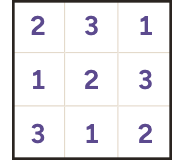
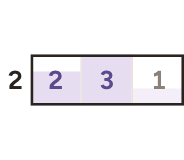
A line with 2 3 1 seen from the left shows two towers: the 2, then the 3. The 1 stands hidden behind the 3. Some ends carry no number. No squares are given. Exactly one way to fill the grid fits every number.
How to play in Rather
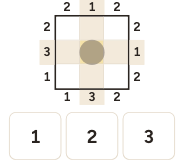
Tap a square, then a height on the keypad. Tap the same height again to clear it. Each height you place stands as a lilac bar, taller for bigger heights, so the grid fills like a skyline.
Notes pencil small candidates into a square. Undo steps back through every change.
A number dims once its line is full and shows exactly that count. It checks the count, not whether the heights are right.
Where to start
Start with the 1s at the edge. A 1 sees only one tower, so the tallest one stands in the square at that end.
The biggest number says every tower is in view. On a 4×4, a 4 at the edge means the row reads 1 2 3 4 from there.
Use the rule of the grid. A height that fits in one square only, in its row or its column, goes there. A square with one height left takes it.
Look at a 2. The tallest tower can’t stand first in that line, since then you would see only one. That rules the biggest height out of the square at the edge.
A number also rules heights out. A 3 on a 4×4 needs three towers in view, so the 4 can’t stand in the second square: only the first and the 4 would show.
When you’re stuck
Tap Hint. It clears wrong heights first, then places the next heights you could work out, simplest first. It says why: “A 1 sees only the tallest, so 4 stands right here.”
When nothing can be placed, it rules heights out until one opens. Often it names what opened it: “Too tall this close to the 3, so 2 goes here.”
The numbers and squares it read are outlined. The squares it fills glow once. The hint ignores your notes.
Errors underlines heights that differ from the solution. It says when a height repeats in a row or column. It also says when a number sees a different count.
Sizes
- Easy 4×4 Every number shown.
- Medium 5×5 Some numbers left out.
- Hard 6×6 Fewer numbers still.
Questions
Does a number count the towers or the heights?
The towers you can see. A 3 means three towers stand in view from that end, whatever their heights.
Why do some ends have no number?
Medium and hard leave some out. The rest are enough for one answer, so you never have to guess.
Are any squares filled in at the start?
No. The numbers around the grid are all you get.
Try another
- Math cages Every cage hits its number
- Number grid Every row, column and box, 1 to 9