 Rather
One closed loop, the numbers count its sides
Loop
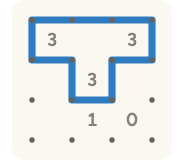
One closed loop along the dots. Each number says how many of its four sides the loop uses. Tap a side to draw it or drag from dot to dot.


How it works
-
-
-


Key
-

-

-

-


What you get from it
A puzzle of small certainties. A 0 rules out four sides at once. A 3 in a corner takes two. Each side you settle makes the next one easier to see.
It trains seeing the whole shape. The loop has an inside and an outside. On hard boards, that is what finishes it.
Easy is a 5×5 with most squares numbered. Hard is a 9×9 where fewer than half are.
Rules
A grid of dots with a number from 0 to 3 in some of the squares between them. Draw one closed loop along the sides between dots. It never branches or crosses itself.
Each number says how many of its square’s four sides the loop uses. A square without a number says nothing. Exactly one loop fits.
How to play in Rather
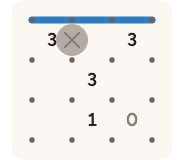
Tap a side to cycle it: a line, then ×, then empty again. The × is your own note for a side the loop leaves out. A tap acts when you lift your finger.
Drag from dot to dot to draw every empty side you pass. A drag that starts on a line erases instead. ×s stay put either way. One drag is one Undo step.
A number dims once that many of its sides are drawn, so a 0 starts dim. It counts the lines without checking them.
On a keyboard, the arrows move between sides, Tab turns from across to down, Space or Enter cycles the side and Backspace clears it.
Where to start
Start with the 0s. All four of their sides are out, so put an × on each.
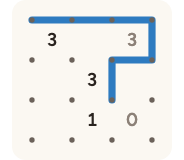
Then look for 3s. Two 3s side by side: the loop takes the side between them and the outer side of each. Two 3s on a diagonal: it takes their two outer corners.
Watch the dots. A dot with two lines is done, so its other sides are out. A dot with one line has to go on, because the loop never stops.
Corners help too. A 3 in a corner of the board takes both corner sides. A 1 there leaves both out.
Keep an eye on the loop as it grows. A side that would close a small loop before the whole one is done is out.
Hard boards need inside and outside. Every square is either inside the loop or outside it. A line runs exactly where the two meet, so two squares on the same side never have a line between them.
When you’re stuck
Tap Hint. If a line or × is wrong, it clears it: “This one doesn’t fit.” Otherwise it marks what one technique settles, lines and ×s alike. It says why: “Diagonal 3s take their outer corners.”
The squares and dots it reads are outlined. The sides it marks glow once.
Errors marks every line that isn’t on the loop and every × that is.
Undo takes back a whole drag at a time.
Sizes
- Easy 5×5 55 to 70 % of the squares numbered.
- Medium 7×7 45 to 60 % of the squares numbered.
- Hard 9×9 35 to 50 % of the squares numbered.
Questions
Can the loop cross itself?
No. It never crosses or branches: every dot on it has exactly two of its sides drawn.
Do I have to mark the ×s?
No. They’re your own notes. The puzzle is solved when the lines are exactly the loop, whatever ×s are on the board.
Is there only one loop?
Yes. Every puzzle has exactly one loop that fits. The hint follows it.