 Rather
Zeros and ones, never three alike
Binary grid
Only zeros and ones, and a few plain rules. Each square has one right digit.
Also known as takuzu.


How it works
-
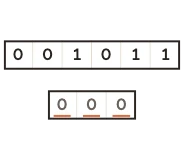
-
-
-
-


Key
-

-


No two rows the same, no two columns the same.
What you get from it
Fast, satisfying logic. The rules are simple enough to hold in your head, so you can play in a quick, steady rhythm, and each move tends to unlock the next.
Much of it is seeing shapes at a glance: a pair here, a gap there.
On a 10×10 the counting gets real, five of each digit per line, and the middle line helps you see the halves.
Rules
Fill every square with 0 or 1. Never three alike in a row or column. Every row and column holds as many 0s as 1s. No two rows are the same, and no two columns. There is exactly one way to fill it.
How to play in Rather
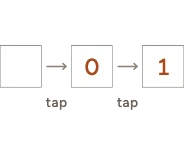
Tap a square once for 0, twice for 1, and again to clear it. Bold digits are given and don’t change.
A thick line through the middle halves the grid, so counting is easier. Undo steps back through every tap.
Where to start
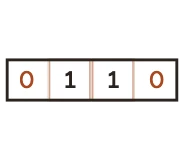
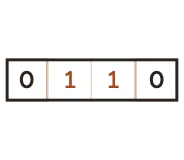
Look for pairs. Two 1s side by side? The squares at both ends must be 0, since three alike is never allowed.
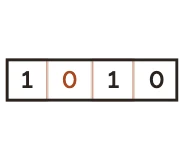
Then sandwiches: 1, gap, 1. The gap must be 0.
Then count. A row of six that already holds three 0s fills the rest with 1s. Near the end, two rows that could finish the same way can’t: the other order is the right one.
Count with the halves. The thick middle line splits each line in two, so you see at a glance how many 0s and 1s are placed.
Late in a puzzle, try the few ways a line could still finish. Squares that come out the same every way are safe to fill.
When you’re stuck
Tap Hint. It clears wrong digits first, then fills what one rule decides, simplest first, and says why: “No three alike: next to two 1s comes a 0.”
Errors underlines digits that differ from the solution, and names a broken rule: three alike, too many of one digit in a line, or two lines the same.
Undo takes back any tap, so you can step back to the last point you were sure of.
Try each way to finish a line
Pick an empty square in a nearly full line and pretend it is one digit. Fill in what the line then needs. If every way to finish the line then breaks a rule, three alike or too many of one digit, the square is the other digit. You never leave that one line, so every step follows from the line itself.
Take a row of six with a 1 at each end. It needs three 0s and one more 1. If the second square were 1, the other three would all be 0s. Three 0s would sit side by side. So the second square is 0. The fifth is too, seen from the other end.
No two lines the same
When a line has two squares left, one 0 and one 1, try both orders against the finished lines. Rows are compared with rows and columns with columns. If one order would copy a finished line, the line takes the other.
Here row 1 is done and row 4 has two squares left. A 0 then a 1 would make row 4 a copy of row 1. So it is a 1 then a 0.
Sizes
- Easy 6×6 Three of each digit per line.
- Medium 8×8 Four of each.
- Hard 10×10 Five of each.
Questions
Does a line need to be finished to break the “no two the same” rule?
Yes. Only two complete rows, or two complete columns, can be the same.
Is it about binary numbers?
No maths at all. 0 and 1 are just two symbols.
Can I mark a square without committing?
No notes here. Undo takes back any tap.
Try another
- Stars One per row, column, region
- Number grid Every row, column and box, 1 to 9