 Rather
Every cage hits its number
Math cages
A small grid of numbers and signs. Every cage makes its number, and nothing needs a guess.


How it works
-
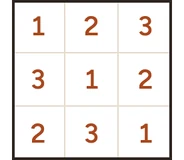
-
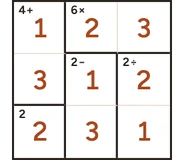
-
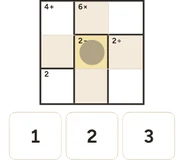


Key
-

-

-

-


What you get from it
Mental arithmetic with a purpose. You add, subtract, multiply and divide small numbers, but the real work is logic: which pairs can make 3−, and which of them still fit the row.
The grids are small, 4×4 to 6×6, so a puzzle fits in a few minutes and still asks for a real chain of thought.
Small facts come back from one puzzle to the next: on a 6×6, a two-square 12× is always 2 and 6 or 3 and 4.
Rules
Use each number from 1 to the grid’s size once in every row and every column. Thick lines cut the grid into cages. Each cage shows a target and a sign in its corner, like 12+, 3−, 24× or 2÷, and its numbers must make that target with that sign.
Subtract and divide cages have two squares: the larger number less, or over, the smaller. A one-square cage just shows its number. No squares are given.
Each puzzle has exactly one way to fill it, and it never needs a guess.
How to play in Rather
Tap a square, then a number. The square turns butter yellow and its row and column are washed. Tap the same number again to clear it.
Notes pencil small candidates under the cage label. Undo steps back through every change.
Where to start
One-square cages are free: write their numbers first. Then look for cages with few ways to make their target. On a 4×4, a 3− cage can only hold 1 and 4. On a 5×5, a two-square 12× can only be 3 and 4.
Once a cage has one empty square left, its number is fixed: “This cage needs 2 here to make 5+.” And as in any grid where each number appears once per line, a number that fits nowhere else in its row goes in the one place left.
Big products help too: on a 6×6, a two-square 30× can only be 5 and 6. When a cage has only one pair that works, write the pair in Notes and let the row decide the order.
When you’re stuck
Tap Hint. It clears wrong numbers first, then places the next number you could work out, simplest first, and names the cage or line that decides it: “Only 5 here can make 11+ in this cage.”
Errors underlines numbers that differ from the solution, and says when a full cage misses its number.
The hint ignores your notes and works from the numbers you placed.
Sizes
- Easy 4×4 Add, subtract and one-square cages.
- Medium 5×5 Every sign.
- Hard 6×6 Every sign, on a bigger grid.
Questions
Can a number repeat inside a cage?
Yes, as long as the two squares sit in different rows and columns. An L-shaped cage can hold two 2s.
How does 2÷ work?
The larger number over the smaller makes 2: 2 and 1, 4 and 2, or 6 and 3.
Do I need to be good at maths?
No. The numbers stay small. It’s more about ruling things out than about sums.
Try another
- Number grid Every row, column and box, 1 to 9
- Pattern Find the missing piece